If you've been following the AI agent space, you know the pain: building the agent logic is the easy part. The hard part is everything around it. Sandboxing, infrastructure, state management, error recovery, credential handling. You end up spending more time on plumbing than on the actual agent.
Anthropic just launched Claude Managed Agents (currently in public beta) to take that entire infrastructure layer off your plate. Here's what it is, why it matters, and whether you should care.
The problem it solves
When you build an AI agent today, you're responsible for a lot more than the prompt. You need to:
- Build and maintain the agentic loop (the cycle of thinking, acting, observing, repeating)
- Set up sandboxed environments so the agent can run code safely
- Handle state persistence so the agent can pick up where it left off
- Manage credentials without exposing them to generated code
- Deal with long-running tasks that can take minutes or hours
- Build monitoring and tracing to understand what went wrong when things break
Most teams end up reinventing this infrastructure from scratch, and it eats weeks of engineering time before the agent even does anything useful.
What Claude Managed Agents actually is
Claude Managed Agents is a hosted service from Anthropic that gives you a pre-built, configurable agent harness running in managed cloud infrastructure. Instead of building your own agent loop, tool execution layer, and runtime environment, you get all of that out of the box.
You define what the agent should do (system prompt, tools, permissions), Anthropic handles how it runs (containers, sandboxing, state, execution).
The service is built around four core concepts:
- Agent: The configuration. Which model to use, the system prompt, available tools, and connected MCP servers
- Environment: A container template with pre-installed packages (Python, Node.js, Go, etc.), network access rules, and mounted files
- Session: A running instance of an agent within an environment, performing a specific task. Think of it as a single "job" the agent is doing
- Events: Messages flowing between your application and the agent. You send instructions, the agent streams back results, tool calls, and status updates
How it works in practice
The flow is straightforward:
- You create an agent definition (model, prompt, tools)
- You configure an environment (what packages are available, what network access is allowed)
- You start a session, which spins up a secure container
- You send the agent a task via events
- The agent works autonomously, running code, reading files, browsing the web, calling tools, and streams results back to you
- You can steer or interrupt the agent mid-execution if needed
The agent runs in a sandboxed container, so it can execute code safely without risking your infrastructure. Credentials are kept outside the sandbox and injected securely through a proxy, so the agent's generated code never sees your API keys or secrets.
What makes it different from just using the API
The regular Claude Messages API gives you direct access to the model. You send a message, you get a response. If you want agentic behavior, you build the loop yourself.
Managed Agents gives you the loop, the sandbox, the state management, and the infrastructure. The key differences:
- Long-running execution: Sessions can run for minutes or hours with hundreds of tool calls. The infrastructure handles checkpointing and recovery automatically
- Built-in tools: Bash, file operations, web search, web browsing, and code execution come out of the box
- MCP support: Connect external tool providers through the Model Context Protocol
- Stateful sessions: File systems persist across interactions. The agent remembers what it did and can pick up where it left off
- Performance optimizations: Built-in prompt caching and context compaction so long sessions don't degrade in quality
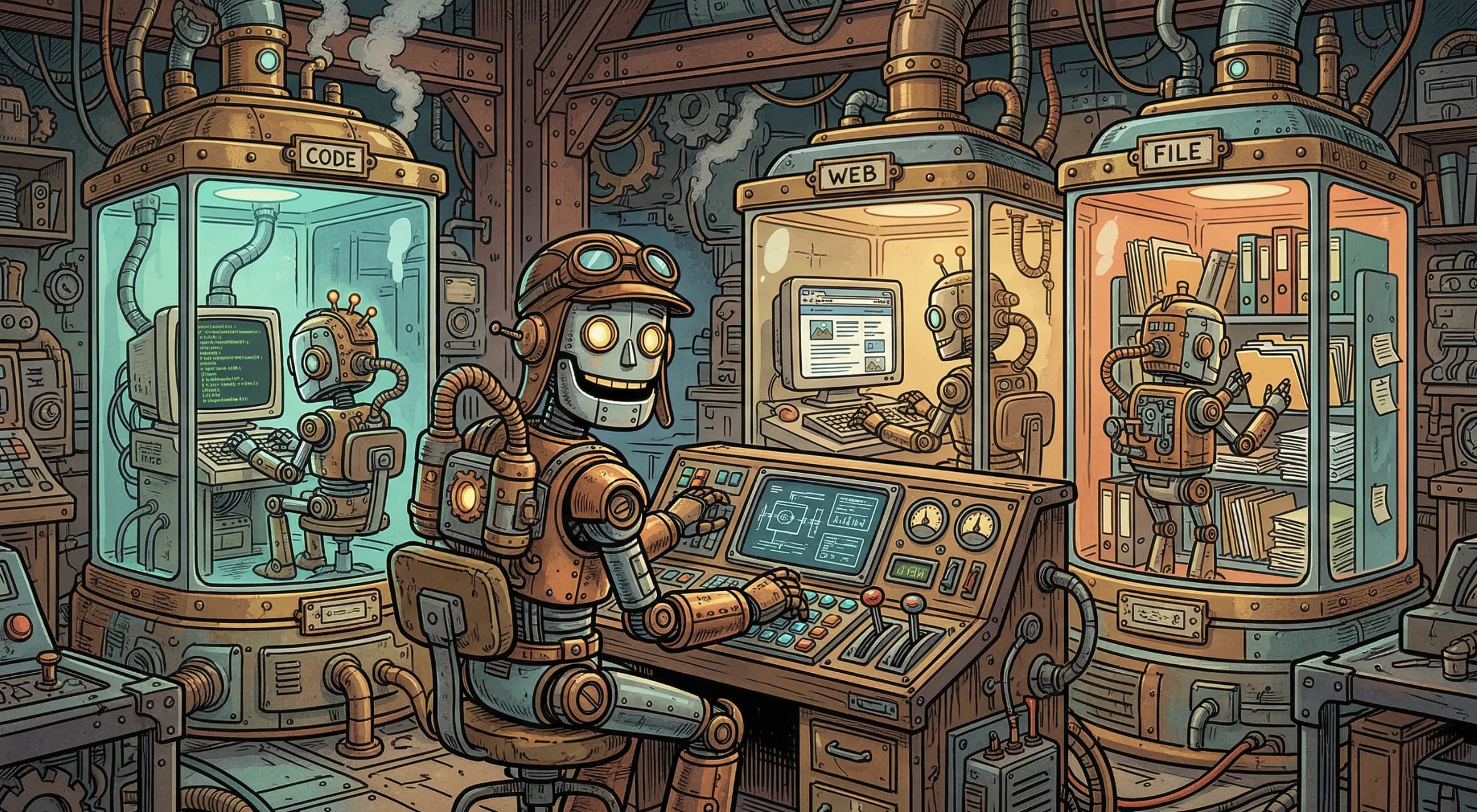
Anthropic's engineering blog describes the architecture as decoupling "the brain" (Claude + harness) from "the hands" (sandboxes and tools) and "the session" (event log). This means the harness is stateless and can be replicated, containers are provisioned only when needed, and sessions are durably stored. The result: their time-to-first-token dropped roughly 60% at p50 and over 90% at p95 compared to the coupled architecture.
Who's using it
The public beta launched on April 8, 2026. Early adopters include companies like Notion, Rakuten, and Asana, which are already building on the platform for use cases like collaborative workspace delegation, enterprise agents in Slack, and automated workflows.
Pricing
For current pricing details, check the official Claude Managed Agents documentation. You pay standard Claude API token pricing plus an additional per-session-hour fee for active runtime.
Should you care?
If you're building AI agents and spending significant time on infrastructure (sandboxing, state management, credential handling, error recovery), Managed Agents removes that entire layer. You focus on what the agent does, Anthropic handles how it runs.
If you already have a solid agent infrastructure in place, or you need fine-grained control over every aspect of the execution loop, the regular Messages API still gives you that flexibility.
The trade-off is the usual build-vs-buy calculation: less control in exchange for less maintenance. For most teams building production agents, that's a trade worth making.